At my last birthday, I turned 49. I never was a whiz at math. I struggled through Algebra 2 in high school, and I believe I took college Algebra twice. I have battled with focus for all of my life (that I can remember). Ironically, I’m pretty quick at simple math, and have learned along the way that the concept of simplification can be quite helpful: i.e., that a more complex math problem, or mathematical computation can be reduced to the simplest form resulting in greater ease of understanding. But at 49, I’m starting to think about things less systematically and more missionally. Put another way; I, like many others from protestant Christian tribes, have thought about faith in terms of a system, or a formula for a very long time. We’ve taught it that way. We’ve not often thought of the gospel, of faith, and of our daily walk as participating in the mission of God.
Our faith walk is a walk each of us walks alone – alone, in the sense of owning the responsibility – each of us. I am asking questions I never asked before and experiencing joy I never could have experienced before now in my walk as a disciple.
It’s taken me a while to come to these thoughts, but I’ve come to believe that many churches around the world have made a math problem out of our faith. My motive in this article is to simply bring about some sober reflection. Let me explain. THE PROBLEM and THE PATHWAY HERE
Drew Ellis
Over the course of time, the church has both oversimplified and overly complicated “church.” We live in a post-Christian world.[1] Anyone living in the world nowadays knows mostly the current world, and is largely oblivious to everything that has contributed to our current context. Today, for example, we “know” all about space flight, genetic fertilization, and routinely use an invisible library of endless information called the internet. Things that are common knowledge today were once beyond our imagination as humans. To know our world without understanding the advances that led us to this point spiritually reveals us woefully ignorant of the processes of discovery and culminaton of the present. All of that is to say we often forget (or never knew) what all factored into our practices and traditions.
By and large, I find that in matters of faith and practice, church-folk have understood Christianity in general only as we have personally experienced things in the 20th-21st century western world. In the spiritual heritage in which I was raised, I was accustomed to a Sunday gathering for “worship”, in which we would convene at the meeting house for a collective assembly of songs, prayers, weekly communion, sermons, and a financial collection. In addition, we would have a 45-min. block of class study time.
In this formula of religious expression, I began to understand the world in terms of a Christianity which was compartmentalized. Church “things” were done at church, rather than a focus on “church” being the church in everyday mundane activities. The church living out the church daily, and participating in God’s mission for redeeming us and bringing us to maturity. Out of that history even developed a plan of salvation. A formula, if you will. Formulas and lists are helpful for categorizing, and sometimes for simplifying discussions; so I get it. I understand how one might wonder that great question, “What must I do to be saved?” – which is the most important thing to ask for every person. Often times we can expect a formulaic response for the sake of simplicity.
Who knows what all has factored into our compartmentalization of church – perhaps it’s a history that viewed it like the silly chart at the bottom of the page, that merited a wife who “sends children to church or Sunday school and goes herself.” Or ideas such as, “she lets husband sleep late on Sunday and holidays.” Clearly segmenting church into a class by itself, which merited/demerited church attendance. There is enormous value in established assembly times and gathering together for the mutual edification of the assembly; but of course, it’s far more than merit or points.
At some point for many people, worship became relegated only to the assembly time, rather than the daily sacrifice of holy living in submission to God. Compartmentalized Christianity is, after all, an easier task than the more daily engulfing story of God being worked out in a disciple’s identity in Jesus. The former great Jewish church persecutor turned evangelist, Saul of Tarsus (later referred to as Paul) said something about this:
“Therefore, brothers and sisters, in view of the mercies of God, I urge you to present your bodies as a living sacrifice, holy and pleasing to God; this is your true worship. -Romans 12:1 (CSB)
The New Living Translation uses a little clearer verbiage, like this:
“And so, dear brothers and sisters, I plead with you to give your bodies to God because of all he has done for you,. Let them be a living and holy sacrifice – the kind he will find acceptable. This is truly the way to worship him.”
The idea of sacrifice has always been connected to worship. Take Abraham as an example. In Genesis 22:5, Abraham told his servants to stay with the animals while he and the boy “go over there and worship[2].” The word worship (in Genesis) is intensely focused in Abraham’s mind; connected to sacrifice. Yahweh commanded Abraham to take his son – the son of promise, born as a miracle in his old age – and offer this son as a sacrifice. As Genesis records the occasion, Abraham was stopped in the process before he killed his son, once Yahweh understood Abraham would faithfully obey. In a similar vein, for Paul, the word in Romans 12:1 means to trulyworship, by living and walking daily in the holiness of God.[3] While this is a different idea than collective worship, it’s easy to see how we might miss the point.
Nobody meant for that to happen… for worship to only be done in an assembly; and many people haven’t really even thought about it. I don’t judge that, and certainly don’t think it was intentional. After all, gathering together is of critical importance according to Hebrews 10:24-25, and it results in power and strength to walk in a way that stimulates holiness in each other. This is simply the way it was experienced for me. The net takeaway was this: we often unintentionally limited “worship” to the meeting house on Sundays or Wednesdays. So how did this become a math problem? How do these concepts over-simplify? Let’s dig deeper.
As the product of repetition, things often become connected to numbers, ratios, and fractions. Frequency breeds metrics. And metrics are akin to the results we seek to understand from any given situation. One thing that greatly concerns me is that through the years – and I mean many years – we have made the Christian faith into a math problem which functions a bit like the scientific results of an equation.
The take–away, the bottom line. Not so much concerned with the formula or process to have a perfect answer, but in terms of the efficiency; the simplifying of the result. The traditional Christian theological formula (regardless of spiritual heritage) typically goes something like this:
God exists… (fact) >In love, humanity and all creation was created >Humanity chose sin; both corporately [Eve and Adam], and actively [as in each subsequent person] >God’s redemptive process seeks to repair the brokenness >Moses brought a law for a chosen people, the Hebrews, as a typological model for God’s desire for all humans >Mosaical law wasn’t perfect; because no person is perfect -> except Jesus of Nazareth, who was God’s ordained contingency for said brokenness >Jesus, then, came on the scene, lived as the perfect substitute for humanity, and died as an atonement for sin, as a perfect fulfillment of Mosaical law, and all Jews and Gentiles can be justified from sin (saved, or be snatched from eternal damnation because of sin separating us from God; not so much an angry God seeking vengeance) >If we accept Jesus as the Messiah, the anointed one of God, we will obey him, emulate his life, and we will be “saved”. >If we become saved, we have past sins forgiven, future sins atoned for as we penitently acknowledge them to God and one another, and we go to Heaven when we die (varying convictions on how and when this happens) as an eternal reward.
I think the list above recounts the Biblical story of God with humanity fairly well; and yet I have simplified it to a list. If one were to dig deeply into each of those topics, it may take months or years to begin mastery of knowledge. We therefore, have a long, and complicated story, though we sometimes simplify it for conversation, or even for the sake of teaching. Having said this, there are so many factors that may influence WHY we think in terms of a simplified, reduced form Christianity.[4] What about the mission of God being one in which we participate as children of God?
Let me make an important distinction here: by “simplified,” I don’t mean concepts that are helpfully simplified because they are highly complex in theology. Helpful simplifications might be referred to, such as Paul’s anthem-like hymn in Philippians 2, “Have this attitude in you that was in Jesus the Messiah…” After all, how can we possibly fully comprehend how the Son of God can become one of us, and bring God into human flesh? Paul takes the pouring out (kenosis) of Jesus from the form of deity “into humanity” and makes a complex idea practical. That’s an example of a helpful simplification.
What I am differentiating here is an oversimplification of bigger concepts that shouldn’t be simplified. Salvation, for example, is a concept that is deep and rich, but not too hard to understand. One may study deep and long to understand it, yet on the surface, it may be obeyed with a continued thirst for that living water. In the churches of Christ, long ago, a pathway to discipleship became a 5-point plan for “getting” saved. It seems sometimes we’ve become so accustomed to reducing to simplest terms that we may ask, “just what do I have to do to be saved?” in a sort of ritualistic approach. Case in point – we have honed in on Acts 2:38 as a process sometimes without understanding v. 36-37 (or the previous 25 verses). We need to find a way to cherish the message without undermining its simplicity and theological significance. The crowd on Pentecost Sunday asked a simple question, “What must we do?” We have sometimes reduced that epic event to a formula which we follow 2000 years later, without having the contextual understanding the Jews had on that day. Again, I’m not opposed to simplification; but I believe over-simplifying has brought about some unintended consequences.
Before we knew it, there were several unwanted, and unintended side-effects of reducing to simplest form:
1. Compartmentalized Christianity = Segmenting off our Christian walk from other aspects of our daily existence (such as the silly graphic on p. 1), not integrating daily as identity. 2. Misconstrued Faithfulness = attendance to the church gathering primarily, but not exclusively as a means of gauging “faithfulness” to God; not gathering for spurring to good deeds, but to safely land away from the judgment of others about our absence. 3. Transactionally/Systematically Oversimplified = The reason for church was that we might fit into a category: saved or lost. Not saved? Oh, you better GET saved!
For most of Christian history, the bulk of humanity was either illiterate or incapable of routine “Bible study” due to a lack of resources. The gospel story was told by word of mouth; by preachers, teachers, and lay persons who were disciples of Jesus. We most likely take that for granted… with all of the superfluous cheap, quick, and even fancy premium Bibles that are everywhere today in print. Tablet, smartphone, computer apps and websites are also teeming with free Bible translations and resources.
It seems to me that we have often read our Bibles with our eyes glazing right over the big picture of God’s story, and laser-focused on the most reduced form: salvation so I may get to Heaven. What must I do to go from lost to saved is a critically important, and Biblical question. But we must re-think the importance of the goal (telos) of God in humanity. But we often just don’t have time these days… After all, it’s the information age, and there are just too many things to read, watch, and digest. Tell it to me simple!
It seems the church has often missed the mark because of this, as we’ve sometimes focused on the results of religion and the Christian faith; because that’s what we do with most everything in life. Results. The Takeaway. Cliff’s Notes. And of course, when we look at results, we often become self-centered: I’ve done what was asked, now let me have my reward.
I think we’re more concerned with a gospel message that tells me some good news about mysalvation from my sins, because after all, that affects me! Before we know it, salvation has all too often been reduced to a transaction, and been simplified for the Christian experience. At the risk of repeating myself, this I’m sure, would never be the intent in learning or teaching the gospel – to reduce to a transaction. It reminds me of the great old baptism hymn O Happy Day which verbalizes the phrase, “’tis done, the great transaction’s done. I am the Lord’s and He is mine.” The story of the gospel is not just about me, it’s about what God is doing through Jesus in the kingdom. What is God trying to do to the world, to reshape it, to redeem it, and what is He building that I’m a part of? Salvation has sometimes been simplified to “what it’s all about” because it’s how each person chooses to respond and be a part of His kingdom reign. However, it’s not just about getting atonement – the forgiveness of sins and being made right; it’s about a revolution in my life starting now; a revolution that changes the way we do everything, in which the king is rightly placed on the throne in all aspects of life. Thy kingdom come, thy will be done on earth as it is in heaven.
At this point you may pause and ask, “wait, doesn’t the gospel of Jesus teach that in salvation we receive atonement for sins?” Without question, it does. But is that all? Jesus said he came so that we might have life and have it abundantly in John 10:10. Not simply that we may have a pre-purchased ticket to Paradise with the Lord out in the far-distant future. How about life now? What’s my value now? What’s the benefit now?
Sometimes, the question is asked: “Are you saved?” Well yes, I am! So that’s it; end of discussion.[5] Without intending to do so, we repeat the Gospel Plan advocated by T.W. Brents in The Gospel Plan of Salvation.[6]His book helped shape generations of preachers over the last 150 years and is still an excellent read. And what has continued is an “easy-believism” of a Gospel story through the years.[7]
Biblical salvation (the study ofsoteriology) is much bigger than getting oneself from lost to saved, and into the correct column of the Lamb’s book of life. I believe we’ve formulaically simplified to its simplest form a “plan” of salvation to be results oriented… not a life-changing paradigm. Not a new creation… but a momentary reprieve from the guilt of our sins by declaring Jesus; or maybe even the fear of going to Hell. The Biblical story tells a story that is much more compelling.
THE POINT
“In the days of those kings, the God of the heavens will set up a kingdom that will never be destroyed, and this kingdom will not be left to another people. It will crush all these kingdoms and bring them to an end, but will itself endure forever. –Daniel 2:44
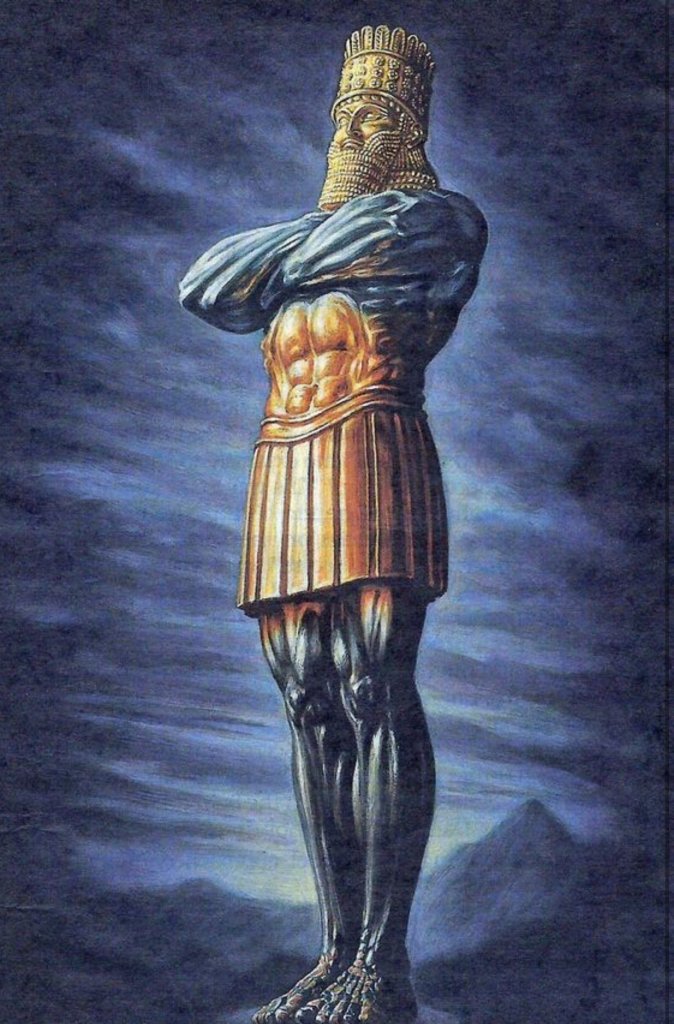
The Hebrew prophet Daniel, exiled in Babylon, was well respected as a prophet of exceptional talent. He explained a dream to the Babylonian king, Nebuchadnezzar around 580 BC, in which a magnificent statue fashioned from all types of precious substances created a statue of a god-king; representing the greatest kingdom regimes of the earth through time. In the dream, a boulder from a high mountain dislodged and rolled down the mountain, pulverizing this statue into dust. This boulder was to represent a “kingdom that will never be destroyed…” – the kingdom of Jesus of Nazareth, the Messiah son of David.
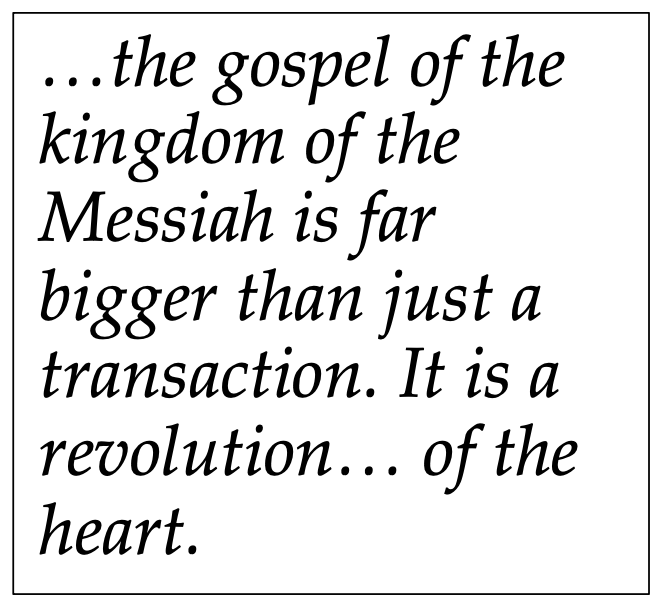
I believe the gospel of the kingdom of the Messiah is far bigger than just a transaction. It’s more than getting saved. Submission to the gospel of Jesus is a revolution, a revolution not in armies or guns or tanks, but of the heart. A revolution that acknowledges that the way of salvation is the way of living in the kingdom of Jesus every day as a citizen of the highest value flag one can fly: the banner of Christ Jesus. More valuable than Babylonian conquest, or the Roman republic, or even American stars and stripes. Daily citizenship in the kingdom is much more than getting saved from sins and eating a communion packet on Sundays. It is the daily drinking from the fountain of living water, and a daily feasting on his body and his blood as John 6 teaches. By the way, John 6’s context may not primarily be about the last supper, but it certainly makes a powerful meditation passage for the communion of that Lord’s Supper and its true meaning. John 6 is teaching that discipleship is about feasting on the ways, teachings, the spirit, the attitude of Jesus. It must be daily for me, to feast upon the daily bread of His life, and also to see what God is doing in the big picture – of which we are a part. John 6 is no doubt recounting Jesus’ teaching that feasting on the body and blood of the Messiah, every day is the source of true food and drink. What better topic could we discuss around the Lord’s table than this?
THE PATTERN BECAME A FORMULA
To revisit an anchor passage of the new testament: Salvation is not just about getting baptized into his name (Acts 2:38). However, baptism is certainly the beginning; the surrender, the burial, the resurrection, the new birth. The passage in Acts 2:38 is a bit of an institution to itself in the churches of Christ. But in truth, there would be no Acts 2:38, without Acts 2:36. In that passage, Peter made a God-ordained closing statement that ripped the hearts of Jewish listeners on that day:
“Therefore let all the house of Israel know with certainty that God has made this Jesus, whom you crucified, both Lord and Messiah.”
Lord and Christ: Κύριον (kurion), which means Lord or master, and Χριστὸν (christon), which means Messiah, or anointed one of God (both are used in the accusative case, which makes them the direct object). The implication is that he is the benevolent master over lives (as opposed to an oppressive master), and the king that will rule the people. Peter here accuses the people of putting to death the one long foretold by the prophets and God himself; the one whose heel will crush the head of the serpent, Satan. It is this revelation that pricks the hearts of the listeners on that day of Pentecost and stirred them to ask how this might be remedied. “What shall we do?” in verse 37 was a question of desperation. Simon Peter responded accordingly as if to say, shift your allegiance to the very one you murdered. Acknowledge him as the Messiah, and ruler of your hearts.
For some folks, this may be a shift of emphasis. You may ask, are you really saying the gospel is not all about being saved? What I am saying is that there is more to our faith than just being saved and going to heaven when we die. Salvation is bigger than we have to understand, but simple enough that we can. Salvation is about the revolution, our atonement, our justification, our sanctification, and a wonderful new life of joy and peace as a result of surrender to the reign of the Messiah in our lives.
THE PROGNOSIS – now what?
We have to re-calibrate. We have to teach better, more in-depth, more substantial Christian concepts in our churches. Not harder… with more complexity; but with greater clarity and articulation.
The good news of the Messiah is not simply whether or not a person is saved or lost; it is that God has finally ushered in his kingdom, under which all things are enveloped in the life of the kingdom disciple who belongs to Jesus. Salvation is a bigger concept than so many people think. We tend to hone in on justification -> the act of becoming justified; forgiven due to the atoning sacrifice of Jesus of Nazareth, and our self-denying submission to his Lordship. Justification is most certainly foundational to salvation. But salvation was a bigger ball of yarn -say- for Israel than it is for us. For them, it was the kingdom reign assuming the throne of David, a Messiah who saves, who judges, who executes dominion over all in our lives – and ultimately over the earth – due to his reign over the kingdom.
Has Jesus ushered in the kingdom in its fullness? Not quite. For certain, it is not yet fully realized due to the fact that we still have sin, pain, brokenness, and the rule of the Messiah isn’t ALL that exists today. That will come in time; and as far as we can read from scripture, it is yet to happen at some point in the future. Traditionally – formulaically – we might say that on the day of judgment, Christ Jesus will fully redeem and fully establish his kingdom.
The kingdom of Jesus is a kingdom that ushers in a redeemed and restored humanity, a restored means of living beginning from the day of your salvation – your declaration of citizenship. This brings about a restored daily perspective and an urgent passion to communicate this kingdom reign to all who live around us, and all over the world by each of us, because of what we’ve begun to experience. As a part of that divine covenant community, we are to live the ideals of our master so the world may see an alternative lifestyle. A life of hope, faith, and love; an a community that exemplifies that love which reflects our King.
The great commission, as we call it, documented in Matthew 28, Mark 16, and Luke 24 wasn’t only for the 12; but it is for all of the kingdom to perpetuate, so the kingdom will continue to grow with each new human, new continent, new city, town, village, or conversation. Not only is it for his disciples to teach, but also to “observe everything I have commanded you.” Obedience is a key attribute of discipleship to Jesus, as it was for himself to the Father.
TO PUT IT PLAINLY…
To put it plainly, I believe we need to rethink the use of our formula. Salvation, citizenship, and kingdom living are much more than a person getting saved. Notably, the New Testament does refer to “being saved,” but it is never an end in itself; not one that led to simply a far-off after-death experience. Salvation in the New Testament signifies the rule and reign of the kingdom of Jesus in us; that his kingdom may come, and his will be done on earth as it is in Heaven.
Getting saved seems to be a phrase some Christian traditions have grabbed hold of as if it was the end of the story. However, upon reaching the Grecian city of Athens in Acts 17, it was said of Paul and Silas:
“These men who have turned the world upside down have come here too… They are all acting contrary to Caesar’s decrees, saying that there is another king—Jesus.” -Acts 17:6-7
Such a documented statement by Luke surely demonstrates that salvation was a necessary component, but only as it falls into the big picture reign of Jesus’s new kingdom. Kingdom reign isn’t just about a simplified result for eternal reward. It begins now as daily life, daily citizenship, and daily submission in a new normal in the kingdom of Jesus. We want everyone to be a part of it.
So the next time you think of an opportunity to bake a dish, perform a service, or do other kingdom things toward your fellow disciples because of the love you’ve experienced in Jesus, think about salvation in terms of the kingdom reign of Jesus in your actions. In fact, it’s a resurrection. The resurrection of a man or woman who has surrendered his own selfish will to the will of Jesus in their lives for the kingdom (Romans 6 breaks this down so well).
So, is this reduced to lowest terms? When we signed on to be disciples of Jesus, we signed up to die. To die to ourselves, to our lusts, to our whims and selfish motives, and to be resurrected to live with new identity and new values. To be a part of colony of Heaven among the Earth – which is hopeless and void of any Godly value outside of His kingdom.
If there’s a math problem to add up, let’s add up the total sum of what we may be when we completely buy into our value as a new creation in Jesus. That’s a formula I can get behind.
[2] Sacrifice is a concept always connected to worship in the minds of Biblical servants of God (וְנִֽשְׁתַּחֲוֶ֖ה – shachah, or “bow down/prostrate in worship”). The connection to this idea for Paul in Romans 12 is by no means foreign; it is quite literally connected to the idea of submission and holiness to God; to worship is connected to sacrifice. So a daily sacrifice of living obedience is connected, here. https://biblehub.com/hebrew/7812.htm
[3] In Romans 12:1, the word “worship” is the root word latreia (λατρεία, from latreuo, which might be best translated as “service” or “offering to God”. https://biblehub.com/greek/2999.htm
[4] The scientific enlightenment, Deductive Reasoning, John Locke, sir Francis Bacon & “rationalism”… Many things have influenced humanity’s progression in thinking systematically and scientifically along the way. In recent history, humanity started thinking mostly in terms of productivity and efficiency. On top of that, the world WE live in was shaped by scientific exploration; but further still today by the advent of the internet.
[5] My particular tradition even labeled a 5-step plan to become saved “the Gospel Plan of Salvation”, and in subsequent years added a 6th step, which we called “remain faithful” or to walk faithfully. While I believe it is critically important to live faithfully, I believe we’re still missing it by reducing the kingdom of Jesus to steps, lists, or an oversimplified “transaction” denoting saved or lost.
[6] Brents, T.W. The Gospel Plan of Salvation, Guardian of Truth Foundation, Bowling Green, KY: 1987 (originally published in 1874). While Brents’ fine work was about far more than simply the plan of salvation, it is easy to see how the name caught on. His book is a master class in Restoration Movement theological thought on a number of topics related to the kingdom.
[7] Bates, Matthew W. Gospel Allegiance: What Faith in Jesus Misses for Salvation in Christ, Brazos Press:Grand Rapids, 2019, 35.


 Droo's Clues