
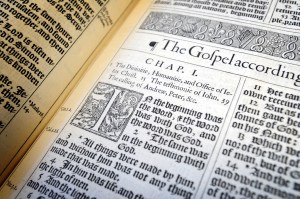
John 1 in the King James Version 1611
Which one is worst? “That NIV ain’t a version, it’s a PERversion!” 🙂
Year Translation Strengths Weaknesses
1611 King James Version Largely Distributed Awkward
1901 American Standard Version Extremely Literal Very Awkward
1952 Revised Standard Version Ease of reading Some bias
1963 New American Standard Literal Readability
1966 Today’s English Version Easy to read Less accurate
1971 Living Bible Readability Very Inaccurate
1973 New International Version Easy to read Bias/Inac.
1979 *New King James Version Easier to read Rev. KJV
1989 *New Revised Standard Easy to read Gender inclusion
1995 *NASB Update Literal/Accurate Readability
2001 *English Standard Version Literal/Accurate Readability
2010 *NIV 2011 Easy/Conversational Somewhat Biased
*All reliable translations, and capable of teaching the lost about Christ with great accuracy.
Elegance, Accuracy, Readability
in Major English Bibles
(scale of 1-10, with 10 being the best score)
| Elegance | Accuracy | Readability | |
| KJV |
9 |
5 |
3 |
| RV |
1 |
9 |
2 |
| ASV |
4 |
9 |
5 |
| RSV |
7 |
8 |
8 |
| NASB |
4 |
8 |
4 |
| NRSV |
6 |
8 |
6 |
| ESV |
8 |
8 |
8 |
| NIV (whole tradition) |
4 |
8 |
10 |
| NET |
7 |
10 |
6 |
At bottom, there is a variety of factors that one must consider when choosing a translation. The three basic translation philosophies—which, incidentally, correspond to the three periods of English Bible translation: elegance (1536–1881), accuracy (1881-1971), readability (1978–present)—are just one way of looking at these translations.
So which translation should you use?
Do you have an affinity for the lack of understandable English, yet the more Regal and Beautiful language of the King James Version? Or would you prefer accuracy, yet more readable NIV 2011? This post hasn’t explored the inaccuracies of the KJV, but rest assured there are several there as well; particularly 1 John 5:5-8 and Hosea 11:12.
It depends on how well you memorize scripture, and how you use the Bible you have in your lap. At any rate, serious students of the Bible do need to consider translations, when reading.

 Droo's Clues